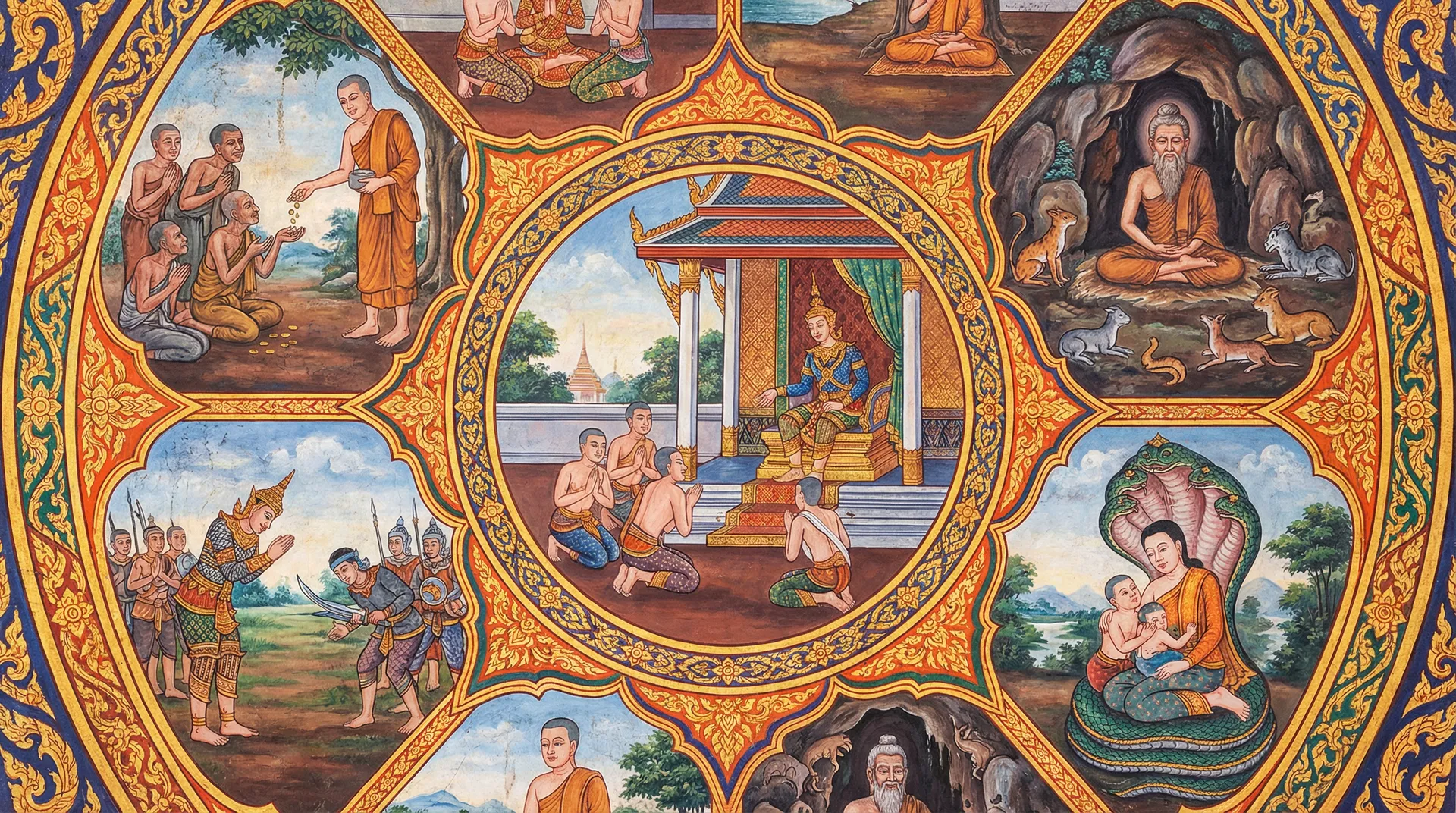
MULAKAPAKSIYA JATAKA
MULAKAPAKSIYA JATAKA
In the vast and verdant forests of India, where ancient trees whispered secrets to the wind, lived a community of monkeys. Among them was a particularly clever and observant monkey, who, in this lifetime, was the Bodhisattva. This Bodhisattva, gifted with extraordinary foresight and a deep understanding of the natural world, lived a life of simple wisdom, guiding his troop with patience and care.
One day, while foraging for fruits, the Bodhisattva monkey noticed something peculiar. A group of hunters, their faces grim and their intentions clear, were setting up an elaborate trap in a clearing. The trap was ingenious, designed to ensnare unsuspecting prey with a net concealed beneath a layer of leaves and branches. The Bodhisattva, recognizing the imminent danger, immediately gathered his troop.
"My friends," he announced, his voice filled with urgency, "we must be vigilant. I have seen hunters who have set a cunning trap that poses a great threat to our safety. We must not venture into that clearing."
The other monkeys, accustomed to the Bodhisattva's wisdom, listened attentively. However, there was one young, impetuous monkey, known for his recklessness and his arrogance, who scoffed at the warning. "Why should we believe you?" he chattered dismissively. "You are always so cautious. Perhaps you are simply afraid. I, for one, am not afraid of any hunter. I will go where I please!"
Despite the Bodhisattva's repeated pleas and explanations of the trap's design, the young monkey remained unconvinced. He boasted about his agility and his ability to escape any danger. The Bodhisattva, saddened by his friend's obstinacy, warned him one last time: "Pride and overconfidence are dangerous companions. They blind us to the perils that surround us." But the young monkey, blinded by his ego, paid no heed.
The next morning, the young monkey, eager to prove his bravery, ventured towards the clearing. As he leaped from branch to branch, filled with a false sense of security, he landed directly in the center of the hidden trap. With a sudden whoosh, the net sprang up, entangling him completely. He struggled and squirmed, but the more he fought, the tighter the net became.
His cries of distress echoed through the forest, reaching the ears of his troop. The Bodhisattva monkey, hearing his friend's panicked calls, immediately rushed towards the sound, his troop following close behind. They arrived to find the young monkey hopelessly caught in the hunter's net.
The Bodhisattva, seeing his friend's predicament, did not scold him. Instead, he assessed the situation calmly. He knew that direct confrontation with the hunters was too dangerous. He also knew that the young monkey, in his panic, was only tightening the net further.
"My friend," the Bodhisattva called out, his voice steady and reassuring, "stop struggling. Your frantic movements are only making your situation worse. You must remain calm. We will find a way to help you."
The young monkey, exhausted and terrified, finally ceased his struggles. The Bodhisattva then began to instruct his troop. "We cannot break the net with our strength alone," he explained. "But we can use our teeth and claws to gnaw at the ropes. We must work together, each contributing a small effort. If we all bite at the same place, we can weaken it."
The monkeys, under the Bodhisattva's direction, began to meticulously gnaw at the ropes of the net. Some focused on one section, others on another. It was slow and painstaking work. The Bodhisattva himself worked tirelessly, his sharp teeth tearing at the tough fibers. He also made sure to keep the young monkey calm, offering words of encouragement and reminding him of the importance of patience.
As they worked, they heard the distant sound of the hunters returning. The Bodhisattva knew they had to be quick. He urged his troop to increase their efforts. Finally, after what seemed like an eternity, a few key ropes snapped. With a final surge of collective effort, the net gave way, and the young monkey was freed.
He tumbled to the ground, bruised and shaken, but alive. He looked at the Bodhisattva and his troop, his eyes filled with gratitude and shame. "You were right," he whispered, his voice hoarse. "My pride nearly cost me my life. Thank you for saving me, even after I ignored your warning."
The Bodhisattva gently groomed his friend's fur. "Do not dwell on the past, my friend," he said. "Learn from this experience. True strength lies not in recklessness or arrogance, but in wisdom, caution, and the ability to work together. Remember that even the strongest among us can fall prey to danger if we are not mindful."
From that day forward, the young monkey was no longer arrogant. He became a diligent student of the Bodhisattva, always listening to his counsel and understanding the value of humility and cooperation. The entire troop lived more harmoniously, their safety assured by their collective wisdom and their unwavering trust in the Bodhisattva's guidance.
— In-Article Ad —
💡Moral of the Story
Pride and overconfidence can lead to great danger. True strength lies in wisdom, caution, humility, and collective effort. Learning from mistakes and cooperating with others are essential for survival and well-being.
Perfection: Diligence
— Ad Space (728x90) —
More Jataka Tales You May Enjoy
 537Mahānipāta
Mahakappina Jataka
The Tale of King Mahakappina and the Joy of Renunciation Long ago, in the prosperous city of Savatth...
💡 True happiness and fulfillment are found not in the accumulation of worldly possessions or power, but in the practice of detachment and renunciation. Letting go of attachments leads to inner freedom and lasting peace.
 36Ekanipāta
The Tale of the Horse-Breeder
In a past aeon, in the flourishing city of Varanasi, the Bodhisatta was born as a young Brahmin, end...
💡 The highest form of virtue is selfless compassion, willing to sacrifice for the well-being of others.
48EkanipātaThe Bodhisatta as the Generous King
The Bodhisatta as the Generous KingIn the ancient and prosperous kingdom of Varanasi, ruled a king n...
💡 True generosity is not deterred by pride or rejection; it finds ways to benefit all, demonstrating the highest form of leadership.
66EkanipātaThe Great Crane Jataka
Long ago, in an age when the Buddha had not yet appeared, in a time immeasurably distant, the Bodhis...
💡 True wealth is measured not by the abundance of possessions, but by the happiness and prosperity of one's people. Greed leads to suffering, while generosity and compassion bring true prosperity.
58EkanipātaThe Great Ocean Jataka
In a land of bountiful shores, where the vast sea met fertile lands, there lay a small fishing villa...
💡 True wealth is found in generosity and compassion, not in material possessions. Greed blinds the mind and leads to self-destruction.
45EkanipātaThe Bodhisatta as the King of the Birds
The Bodhisatta as the King of the BirdsHigh atop the magnificent peak of Mount Gandhamadana, where t...
💡 True courage and generosity, even in the face of extreme danger, can bring life and hope to those in despair.
— Multiplex Ad —